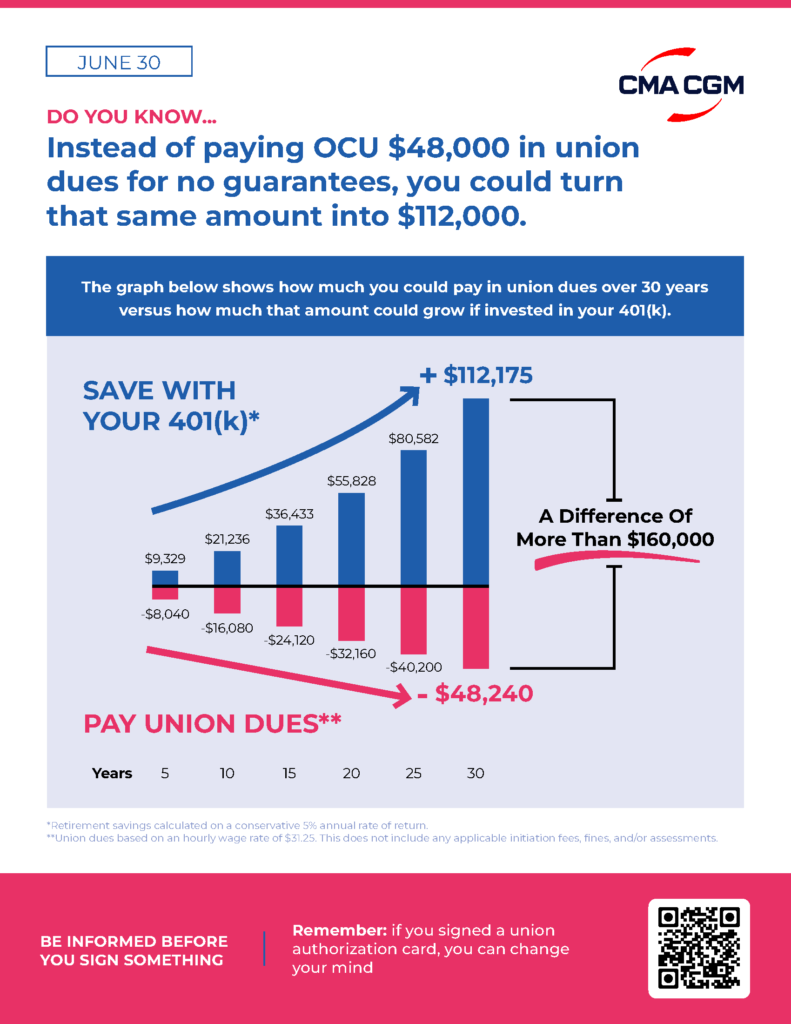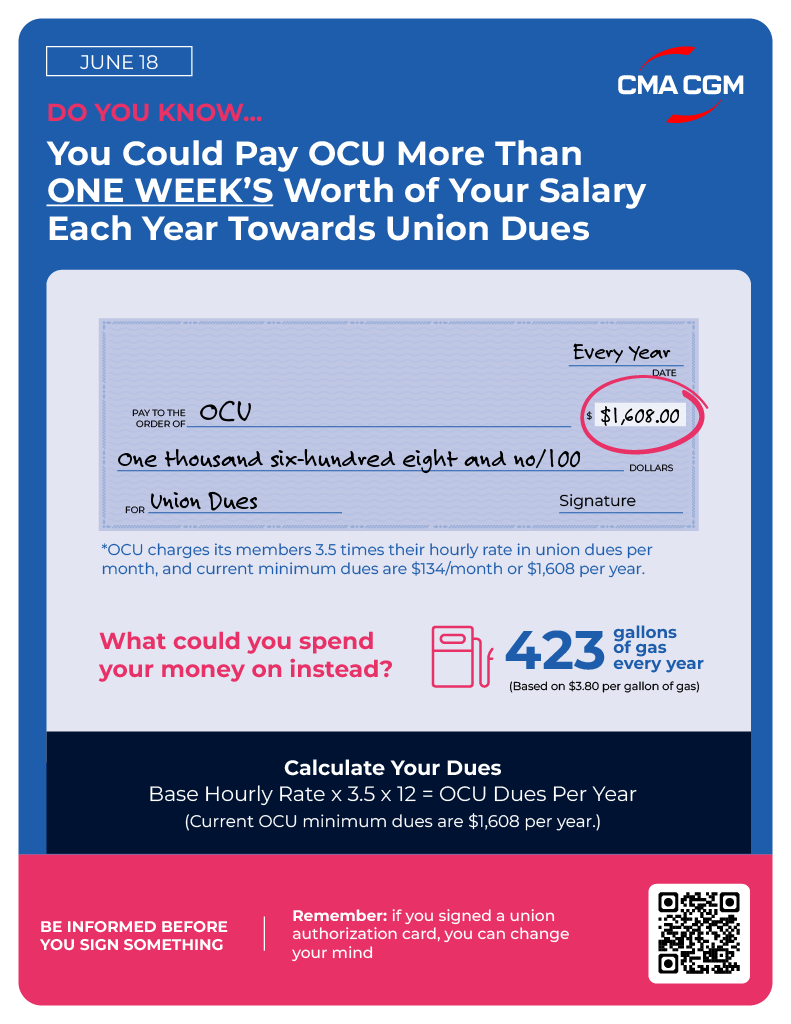
We encourage CMA CGM Associates to explore this website to learn the facts about union representation as well as CMA CGM’s position on unionization and its commitment to supporting Associates and their careers.
We fully respect you and your right to decide whether to pursue potential union representation. We encourage you to carefully consider this decision and take the time to learn about what union representation could mean for you based on facts, not promises a union has no power to guarantee.
Our preference is to maintain our direct relationship with you and to not work through a union, and we are committed to supporting you and your career here at CMA CGM. We value you and the ability to make improvements quickly, based on your direct feedback, without a third-party between us.
A union authorization card is a legal document, and by signing it you state that you want the union to represent you for purposes of collective bargaining for wages, benefits, working conditions and other terms of employment. No matter what you are told, a union card is not a request for more information or to be added or removed from the union’s mailing list. We strongly encourage you to not provide a written or electronic signature or give away your personal information without a thorough understanding of what is involved.
The union can do several things with Associate signatures, whether on an authorization card or other document:
1) If the union gets 30% of the Associates to sign cards, the union could contact the National Labor Relations Board (NLRB) and file a petition for an election to determine if Associates want to be unionized.
2) If the union gets a majority of Associates to sign cards, it could demand recognition from CMA CGM without the opportunity to vote in a secret ballot election.
3) The union may use it to send you mail and to call or visit you at home. Unions might also sell your information to a third party. CMA CGM will never disclose your information to a third party without your knowledge or consent unless required by law.
The decision is yours and yours alone on whether or not to sign a card or petition. Remember, these are legal documents, so be sure you are clear about what you are signing and know your rights. These simple guidelines can help protect you:
1) Ask before you sign: Know what you are signing. An authorization card could be paper or electronic and might not even mention an election, but, rather, simply be presented as a request for information. A union may try to gather employee signatures on documents other than an authorization card too. Read everything carefully and ask how your signature and personal information will be used.
2) Make your own decision: It’s up to you—not us, not the union, and not your co-workers—to decide whether to sign something from the union. And, you should be able to make your decision without any pressure from anyone.
3) Report concerns: Notify your manager about anything that you feel is inappropriate or not in keeping with our security, privacy, or other policies and procedures. There are multiple ways for Associates to report concerns.
4) You can change your mind: If you signed a union authorization card you can take it back.
No. Signing a union card does not mean that you have to vote in support of the union. If an election is held, voting is by secret ballot. No one will ever know how you vote. You do not have to vote for the union in an election even if you signed a card.
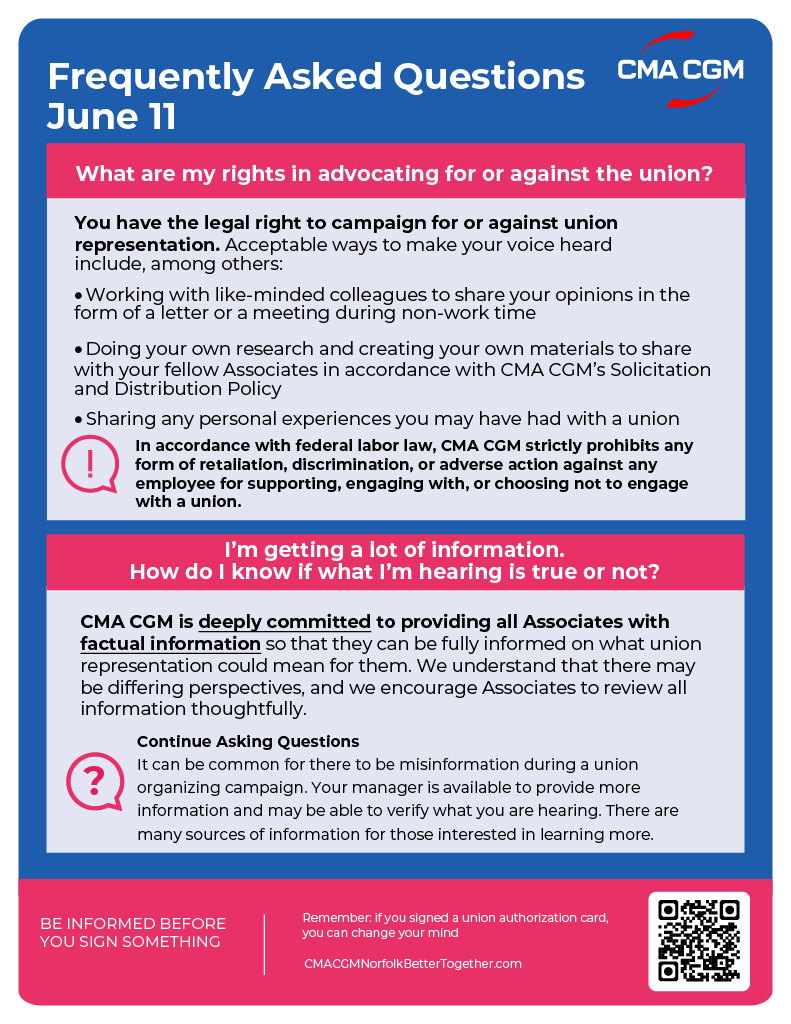
Yes. You have the legal right to speak for or against union representation. Federal law protects your right to talk to your fellow Associates about your views, meet with fellow Associates to make your collective views known, distribute information in accordance with our solicitation and distribution policy and attend meetings to discuss the pros or cons of union representation and the benefits of having a direct relationship with CMA CGM.
No. You are free to speak with or refuse to speak with union representatives or Associates who speak on behalf of or against the union or who visit you or call you at home or at work. There is no law or policy that requires you to speak with union representatives or its supporters, and you are free to respond accordingly.
While we respect Associates’ desire to share appropriate information, you must follow CMA CGM policies and procedures with regard to solicitation, distribution, and bulletin boards. You should not distribute materials during work time or in work areas, engage in solicitation during work time, or disrupt Associates who are working. These rules apply to all non-Company communications and materials.
During a campaign, unions and their supporters have significant leeway to “promise” things like higher wages, more benefits and other changes. However, OCU has no power to guarantee those promises. If a union is elected, the employer is required to negotiate in good faith, and we will comply with our legal obligations. There is no obligation to agree to the other side’s demands. A union can only deliver what CMA CGM agrees to during negotiations. You should consider asking OCU to put down any promises in writing.
Under federal labor law, it’s illegal for CMA CGM to make similar promises to Associates during this time. What we can say is look at our recent track record and the improvements we have made based on your feedback. We greatly value you and everything you contribute here and provide a market-competitive total rewards package.
If a union is voted in, all Associates in the voting group would be represented by OCU indefinitely. Even if someone voted against the union or didn’t vote at all, they cannot opt-out of union representation. That is why it’s so important to gather facts and information about what union representation could mean for you.
First contracts can take well over a year to complete, even longer. During negotiations you will be in status quo, which means your wages, benefits, and other changes generally remain the same. OCU cannot guarantee things like back pay, so you may never make up potential lost wage increases during this time.
No. CMA CGM and OCU would negotiate a brand new, separate contract. Any changes to pay, benefits, or working conditions would be subject to negotiation and would require mutual agreement between both parties. Because of this, outcomes like higher pay or changes to benefits cannot be guaranteed.
For more information on what union representation could mean for you or to verify anything you may be hearing, feel free to submit your questions and comments below. There are many sources of information for those interested in learning more. If you would like to submit a question or comment anonymously, you can do so by simply not providing your name and email in the submission form. Questions of general interest could appear as an FAQ on this website.*
*The Company and its IT department will not take any steps to determine the identity of those who submit questions anonymously unless required by law.
CMA CGM fully respects employees’ rights under Section 7 of the National Labor Relations Act. No statement or document on this website or any page linked to it is intended to prohibit or limit employees from engaging in legally protected activities or activities protected by state or federal law, such as discussing wages, benefits, or other terms and conditions of employment, joining together to improve wages or other working conditions with or without a union’s assistance, bargaining collectively through representatives of their choosing, raising complaints about working conditions for their and their fellow employees’ mutual aid or protection or legally required activities. Employees should not construe any statement or document on or linked to this website to prohibit employees from engaging in legally protected activities.